Import pyOpenMS#
After installation, you should be able to import pyOpenMS as a package
import pyopenms
which should now give you access to all of pyOpenMS. You should now be able to interact with the OpenMS library and, for example, read and write mzML files:
import pyopenms as oms

exp = oms.MSExperiment()
oms.MzMLFile().store("testfile.mzML", exp)
which will create an empty mzML file called testfile.mzML.
Using the Help Function#
There are multiple ways to get information about the available functions and
methods. We can inspect individual pyOpenMS objects through the Python help
function:
help(oms.MSExperiment)
class MSExperiment(pyopenms._pyopenms_kernel.ExperimentalSettings)
 |  MSExperiment(*args, **kwargs)
 |
 |  In-Memory representation of a mass spectrometry experiment.
 |  Contains the data and metadata of an experiment performed with an MS (or
 |  HPLC and MS). This representation of an MS experiment is organized as list
 |  of spectra and chromatograms and provides an in-memory representation of
 |  popular mass-spectrometric file formats such as mzXML or mzML. The
 |  meta-data associated with an experiment is contained in
 |  ExperimentalSettings (by inheritance) while the raw data (as well as
 |  spectra and chromatogram level meta data) is stored in objects of type
 |  MSSpectrum and MSChromatogram, which are accessible through the getSpectrum
 |  and getChromatogram functions.
 |  Spectra can be accessed by direct iteration or by getSpectrum(),
 |  while chromatograms are accessed through getChromatogram().
 |  See help(ExperimentalSettings) for information about meta-data.

 [...]

 |  Method resolution order:
 |      MSExperiment
 |      pyopenms._pyopenms_kernel.ExperimentalSettings
 |      builtins.object
 |
 |  Methods defined here:

 [...]
which lists information on the MSExperiment class, including a
description of the main purpose of the class and how the class is intended to
be used. The base classes of MSExperiment, which contain further
information, are named in the first line of the output and in the
Method resolution order section.
The list of available methods is long and reveals that the class exposes methods such as
getNrSpectra() and getSpectrum(id) where the argument id is
the index of the spectrum; the methods inherited from the base classes follow at the end,
under Methods inherited from. The command also lists the signature for each
function, allowing users to identify the function arguments and return types.
We can gain further information about exposed methods by investigating the
documentation of the base classes:
help(oms.ExperimentalSettings)
Help on class ExperimentalSettings in module pyopenms._pyopenms_kernel:

class ExperimentalSettings(builtins.object)
 |  ExperimentalSettings(*args, **kwargs)
 |
 |  Description of the experimental settings, provides meta-information
 |  about an LC-MS/MS injection.
 |
 |  Methods defined here:

 [...]
In C++, ExperimentalSettings in turn derives from DocumentIdentifier
and MetaInfoInterface. pyOpenMS exposes their methods (for example
getIdentifier and getMetaValue) directly on ExperimentalSettings, so
they are part of its list of methods. For a more complete documentation of the underlying
wrapped methods, please consult the official OpenMS documentation, in this case
the MSExperiment documentation.
First Look at Data#
File Reading#
pyOpenMS supports a variety of different files through the implementations in OpenMS. In order to read mass spectrometric data, we can download the mzML example file:
from urllib.request import urlretrieve

# download small example file
gh = "https://raw.githubusercontent.com/OpenMS/OpenMS/develop/doc/pyopenms"
urlretrieve(gh + "/src/data/tiny.mzML", "tiny.mzML")
exp = oms.MSExperiment()
# load example file
oms.MzMLFile().load("tiny.mzML", exp)
which will load the content of the tiny.mzML file into the exp
variable of type MSExperiment.
We can now inspect the properties of this object:
help(exp)
class MSExperiment(pyopenms._pyopenms_kernel.ExperimentalSettings)
 |  MSExperiment(*args, **kwargs)

 [...]

 |  Methods defined here:

 [...]

 |  getNrChromatograms(...)
 |      getNrChromatograms(self) -> int
 |
 |      Returns the number of chromatograms
 |
 |  getNrSpectra(...)
 |      getNrSpectra(self) -> int
 |
 |      Returns the number of MS spectra
 |

 [...]
which indicates that the variable exp has (among others) the functions
getNrSpectra() and getNrChromatograms(). We can now try these functions:
print(exp.getNrSpectra())
print(exp.getNrChromatograms())
4
2
and indeed we see that we get information about the underlying MS data.
File Summary#
To get an overview of a whole file, use FileInfo, the library
version of the FileInfo TOPP tool. run()
determines the file type, loads the file and returns the collected information:
1result = oms.FileInfo().run("tiny.mzML")
2
3print("File type:", result.meta.file_type_name)
4print("Spectra:", result.peak.num_spectra)
5print("Spectra per MS level:", result.peak.spectra_per_ms_level)
6ranges = result.ranges.spectra_overall
7print("RT:", ranges.rt.min, "to", ranges.rt.max)
8print("m/z:", ranges.mz.min, "to", ranges.mz.max)
File type: mzML
Spectra: 4
Spectra per MS level: {1: 3, 2: 1}
RT: -1.0 to 359.43
m/z: 0.0 to 18.0
result.peak describes a peak file such as mzML; for other file
types, another part such as result.feature, result.ident or
result.fasta is set instead, and the parts that do not apply are None.
result.ranges also holds the ranges per MS level
(per_ms_level), of the chromatograms (chromatograms) and of both
together (combined). The retention time range starts at -1 because the
third spectrum of tiny.mzML has no retention time, and OpenMS stores a
missing retention time as -1.
to_text() returns the report that the FileInfo tool
prints (also stored in result.text), and to_tsv() its
tab-separated version. These are the first lines of the report:
1report = oms.FileInfo.to_text(result)
2print("\n".join(report.strip().splitlines()[:11]))
-- General information --

File name: tiny.mzML
File type: mzML

Instrument: LCQ Deca
  Mass Analyzer: Quadrupole ion trap (resolution: 0)

MS levels: 1, 2
Total number of peaks: 65
Number of spectra: 4
The report continues with the ranges, the spectra per MS level, the
activation methods, the precursor charges and the chromatograms. To add
sections, pass a FileInfo.Options object as second argument to run();
for example, meta = True adds sample, instrument and contact information.
run_all() adds this, the data processing information and
summary statistics. With validate = True, run() validates the file
instead of summarizing it.
Iteration#
We can iterate through the spectra as follows:
Note
Core classes such as MSSpectrum and Peak1D
expose common scalar attributes as snake_case properties (e.g.
spec.ms_level, spec.rt, peak.mz, peak.intensity). These are
equivalent to the getX() / setX() methods, which still work.
for spec in exp:
    print("MS Level:", spec.ms_level)
MS Level: 1
MS Level: 2
MS Level: 1
MS Level: 1
This iterates through all available spectra (MSSpectrum), we can also access spectra through the [] operator:
print("MS Level:", exp[1].ms_level)
MS Level: 2
Note that spec[1] will access the second spectrum (arrays start at
0). We can access the raw peaksthrough get_peaks():
spec = exp[1]
mz, intensity = spec.get_peaks()
print(sum(intensity))
110
Which will access the data using a numpy array, storing the m/z information
in the mz vector and the intensity in the i vector. Alternatively, we
can also iterate over individual peaks objects as follows (this tends to be
slower):
for peak in spec:
    print(peak.intensity)
20.0
18.0
16.0
14.0
12.0
10.0
8.0
6.0
4.0
2.0
Copies, Not References#
pyOpenMS containers use value semantics for element access: every
object you retrieve is an independent copy. Whether you use indexing
(exp[0]), iteration (for spec in exp:) or a getter
(exp.getSpectrum(0), spec.getPrecursors()), the returned object
owns its own data. Editing it does not modify the container, and later
changes to the container do not affect objects retrieved earlier.
A common pitfall follows directly from this: editing the copy does not edit the experiment.
spec = exp[0]
spec.setRT(999.9)      # edits only our copy
print(exp[0].getRT())  # the experiment is unchanged
353.43
To change data inside a container, follow the pattern read it, edit it, put it back:
spec = exp[0]        # read it
spec.setRT(999.9)    # edit it
exp[0] = spec        # put it back
print(exp[0].getRT())
999.9
Why does pyOpenMS work this way? Because the alternative – handing out live references into the container’s internal storage – makes ordinary code unsafe: appending a spectrum can reallocate the container’s memory and invalidate every previously returned object (a use-after-free), and sorting would silently re-bind held objects to different elements. With copies, nothing you hold ever becomes invalid.
Two things complete the picture:
The naming is the contract. As a rule, anything called
getX()orget_*returns a copy you own. The deliberate exceptions end in_view,_viewsor_struct: those return zero-copy views that alias the container’s storage for speed – edits through a view land immediately, but the view is only valid until the container is resized or sorted. Views are introduced in the MS data chapter.Copies cost time on big objects. For read-only sweeps over large experiments, iterate views instead of copies:
for spec in exp.iter_spectrum_views(): ....
Total Ion Current Calculation#
Here, we will apply what we have learned to calculate the total ion current (TIC). The TIC represents the summed intensity across the entire range of masses being detected at every point in the analysis. Basically, we calculate the total ion current of the whole experiment.
With this information, we can write a function that calculates the TIC for a given MS level:
# Calculates total ion current of an LC-MS/MS experiment
def calcTIC(exp, mslevel):
    tic = 0
    # Iterate through all spectra of the experiment
    for spec in exp:
        # Only calculate TIC for matching (MS1) spectra
        if spec.getMSLevel() == mslevel:
            mz, i = spec.get_peaks()
            tic += sum(i)
    return tic
To calculate a TIC we would now call the function:
print(calcTIC(exp, 1))
print(sum([sum(s.get_peaks()[1]) for s in exp if s.getMSLevel() == 1]))
print(calcTIC(exp, 2))
240.0
240.0
110.0
Note how one can compute the same property using list comprehensions in Python
(see line number 3 in the above code which computes the TIC using filtering
properties of Python list comprehensions (s.getMSLevel() == 1) and computes
the sum over all peaks(right sum) and the sum over all spectra (left
sum) to retrieve the TIC).
Total Ion Current Chromatogram#
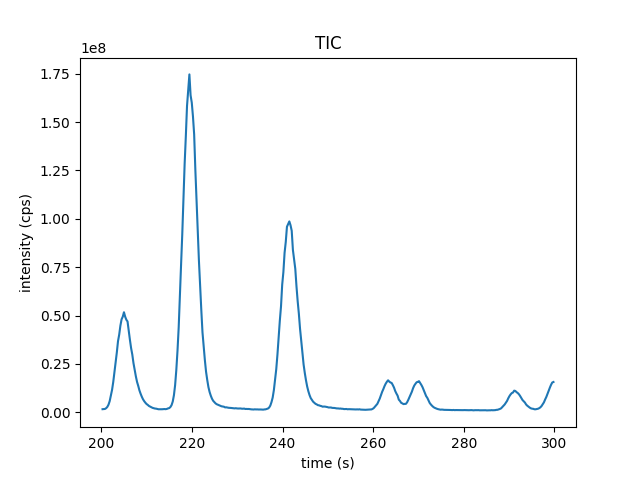
The total ion current is visualized over the retention time, to allow for the inspection of areas with general high intensity (usually multiple analytes were measured there). This can help the experimentalist to optimize the chromatography for a better separation in a specific area.
While some mzML files already contain a pre-computed total ion current chromatogram (TIC),
we will show you how to calculate the TIC for MS1. One can access the retention times
and intensities of the TIC in different ways and generate a total ion current chromatogram
(2D graph) using matplotlib:
 1import matplotlib.pyplot as plt
 2from urllib.request import urlretrieve
 3
 4# retrieve MS data
 5gh = "https://raw.githubusercontent.com/OpenMS/OpenMS/develop/doc/pyopenms"
 6urlretrieve(
 7    gh + "/src/data/FeatureFinderMetaboIdent_1_input.mzML", "ms_data.mzML"
 8)
 9
10# load MS data into MSExperiment()
11exp = oms.MSExperiment()
12oms.MzMLFile().load("ms_data.mzML", exp)
13
14# choose one of the following three methods to access the TIC data
15# 1) recalculate TIC data with the calculateTIC() function
16tic = exp.calculateTIC()
17retention_times, intensities = tic.get_peaks()
18
19# 2) get TIC data using list comprehensions
20retention_times = [spec.getRT() for spec in exp]
21intensities = [
22    sum(spec.get_peaks()[1]) for spec in exp if spec.getMSLevel() == 1
23]
24
25# 3) get TIC data looping over spectra in MSExperiment()
26retention_times = []
27intensities = []
28for spec in exp:
29    if spec.getMSLevel() == 1:
30        retention_times.append(spec.getRT())
31        intensities.append(sum(spec.get_peaks()[1]))
32
33# plot retention times and intensities and add labels
34plt.plot(retention_times, intensities)
35
36plt.title("TIC")
37plt.xlabel("time (s)")
38plt.ylabel("intensity (cps)")
39
40plt.show()